
:quality(75))
The abuse of older people, also known as elder abuse, is a domestic, family and sexual violence matter in the Northern Territory, covered by the Domestic and Family Violence Act 2007 (NT). NT Police view elder abuse – often called ‘older persons abuse’ in the Territory – as ‘a distinct and specialised area of practice’ within the broader field of domestic and family violence,
This categorisation has empowered NT Police to develop a strong focus on the issue. ‘Elder abuse is taken seriously by the police,’ says Acting Assistant Commissioner of the Domestic, Family and Sexual Violence and Youth Command, Hege Burns APM.
The challenges of elder abuse for NT Police
Noting that incidents in the Northern Territory are likely to be under-reported, A/AC Burns acknowledged a number of difficulties that NT Police face in relation to elder abuse.
The Territory’s vast geographic area and significant numbers of highly remote communities affect police response times and limit older people’s access to information, education, legal or other related services.
Community members may lack the knowledge to recognise what constitutes elder abuse.
Where abuse happens within families and homes, older people may be reluctant to lay charges, may withdraw statements after laying charges, or may deny that abuse happened once the immediate crisis has passed.
Older people who experience abuse may also not be able to report it safely.
Witnesses to elder abuse may be reluctant to participate in the older person’s reporting of abuse.
Issues around capacity and consent often weaken police briefs, which reduces the likelihood of prosecutions being successful.
‘In Aboriginal communities, elder abuse intersects with kinship obligations and communal living, substance misuse by younger family members, and respect for Elders, which may make obtaining formal complaints culturally difficult,’ said A/AC Burns.
‘Police must balance enforcement with cultural awareness, and intervention can be perceived as family interference, reducing cooperation and follow-through.’
What is NT Police doing about elder abuse?
A/AC Burns told Compass that for NT Police, a lot has happened in this space in recent years. Initiatives have led to:
improved risk assessment tools
better information sharing
stronger police powers
more training for police officers (more on this below).
Domestic Violence Senior Sergeants in the Joint Emergency Services Communication Centre are available round the clock to provide specialist advice to frontline members dealing with elder abuse situations.
NT Police can refer older Territorians to local, territory and national avenues of support for elder abuse via the national SupportLink referral platform. A referral requires the older person’s consent.
Specialised training about elder abuse
Recruits and in-service officers receive targeted training to equip them to respond appropriately and sensitively to reports of elder abuse. Training channels include the Prevent. Assist. Respond (PARt) training platform for police and health workers in the Northern Territory, as well as specifically focused older persons abuse training sessions. A new online module on elder abuse will be added to PARt soon.
‘This is strengthening members’ capacity to correctly identify older persons abuse as domestic violence and to respond in a manner that is lawful, appropriate and victim-centred,’ said A/AC Burns.
‘We now have a more confident and better equipped workforce, one that is able to see past surface-level presentations and identify the underlying dynamics of older persons abuse more effectively.’
An important element in the training approach is the involvement of community stakeholders in co-delivering training, which draws on shared expertise across the sector.
For example, in late 2025, NT Police took up a valuable opportunity to work alongside the Darwin Community Legal Service to design, coordinate and deliver targeted training on elder abuse for police force members in both the Darwin and Katherine regions. Around 150 members attended the training, with many more having ongoing access to recordings and digital resources.
‘This joint training model enhances operational understanding of Territory-specific legislative instruments, powers and protective mechanisms that may be relevant during police attendances,’ A/AC Burns explained.
‘By contextualising these powers within real‑world scenarios, members are better equipped to identify risk, recognise coercive or controlling dynamics, and apply appropriate safeguards when responding to incidents involving older persons.’
Collaboration is the answer
A/AC Burns firmly believes that collaboration is the way forward. ‘Elder abuse can only be reduced when communities, services, police and governments act together – early, consistently and with the dignity of older people at the centre. Education plays a central role in ensuring elders’ best interests remain front of mind,’ she said.
‘However, lasting change requires education to be combined with support, empowerment, accountability and community engagement. When elders and those around them are informed, supported and resourced, the risk of elder abuse is significantly reduced, and dignity and safety are preserved.’
NT Police interacts with other forces around Australian and in New Zealand to share information, trends data and emerging issues across a range of areas, including elder abuse. The Australia New Zealand Policing Advisory Agency is the central mechanism for this engagement.
As well as participating in many territory and national forums on domestic, family and sexual violence, A/AC Burns said, NT Police also contributes data to, and relies on, national research bodies, including the Australian Institute of Criminology. This helps to identify patterns, gaps and effective interventions for issues like elder abuse.
Report suspected elder abuse to NT Police
What would A/AC Burns say to anyone considering reporting elder abuse to the police?
‘If something doesn’t feel right, speak up,’ she stressed. ‘If it’s not an emergency, take the time to convey your concerns and include the reason that you think elder abuse is occurring, how, by whom, etc.
‘Reporting elder abuse can stop harm, protect dignity and help someone get the support they deserve. Elder abuse is taken seriously by the police, and having an older person’s best interests front of mind will often result in good outcomes for the older person.’
With elder abuse being domestic, family and sexual violence, it’s possible for a domestic violence order to be issued against an abuser. This provides the older person with a higher level of protection, even when there’s not enough evidence to pursue a criminal investigation.
Questions to ask an older person
Suspected older persons’ abuse is Darwin Community Legal Centre’s list of useful, open-ended questions can help you talk to an older person you suspect may be experiencing elder abuse.
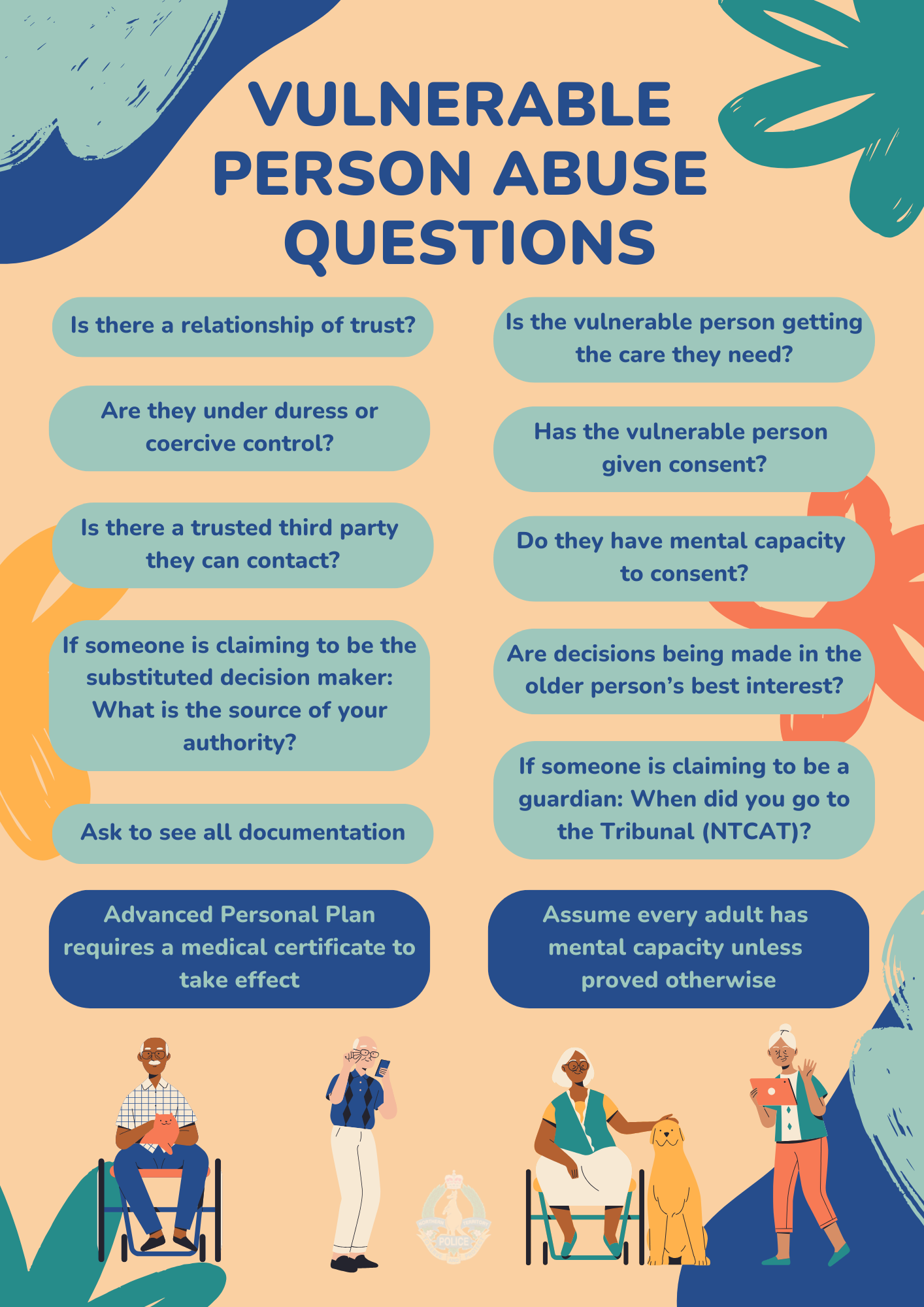
NT Police’s Vulnerable person abuse questions resource can also help you decide whether abuse may be happening.
Helplines
In an emergency, always call 000.
Crime Stoppers 1800 333 000
Elder Abuse Helpline 1800 353 374
Resources
NT Police - website
About the Author
:quality(75))
Acting Assistant Commissioner Hege Burns
Northern Territory Police
Acting Assistant Commissioner Hege Burns is a highly respected and long-serving member ...
All comments are moderated. Please visit our terms of use for guidance on how to engage with our community.